
What’s the News? F-Secure and AMD Silo AI demonstrated how F-Secure Trust technology and AMD Silo AI model routing solutions can work together to help keep consumers’ digital journeys safe, practical, private and efficient in the agentic AI era. The routing approach determines whether each piece of data should be processed on the device or in the cloud, and by which AI model, based on sensitivity, cost, model capability and performance. F-Secure plans to use the approach in the upcoming F-Secure TrustPath solution.
Why It Matters? AI agents increasingly act on consumers’ behalf, including comparing products, managing subscriptions and completing purchases. This creates new security and privacy challenges. Research from F-Secure, a global consumer cybersecurity leader, shows 84% of consumers worry AI makes it impossible to tell what is real online, while 44% worry about using AI itself and only 17% are ready to let AI take actions on their behalf. TrustPath is designed to evaluate each step of a digital journey based on its context rather than extending blanket trust to an entire website.
What’s the Role of AMD?
“The goal is not to send more events to the largest models. The goal is to handle each event as close to the user as possible, to help keep it safe, private and efficient.”
How Does It Work? The companies have developed an approach built on a single principle: Trust is granted per moment, not per domain. A trusted site can still carry untrusted elements, and a routine browsing step can become sensitive the moment an AI agent starts to act with the page content on behalf of the user such as login or payment. Rather than granting blanket trust to an entire website, each step of a journey is judged on its own context. This requires multiple AI models to safeguard the agentic AI operating on the websites.
What Does F-Secure Provide? F-Secure brings its trust model across the consumer journey through TrustPath. Its approach means individual steps are evaluated based on context.
“Consumers will not hand their money, their identity or their decisions to an agent operating under a brand they don’t trust,” said Timo Laaksonen, president and CEO, F-Secure. “Working with AMD Silo AI lets us take F-Secure TrustPath from principle to practice, protecting the whole journey in a practical and comprehensive way.”
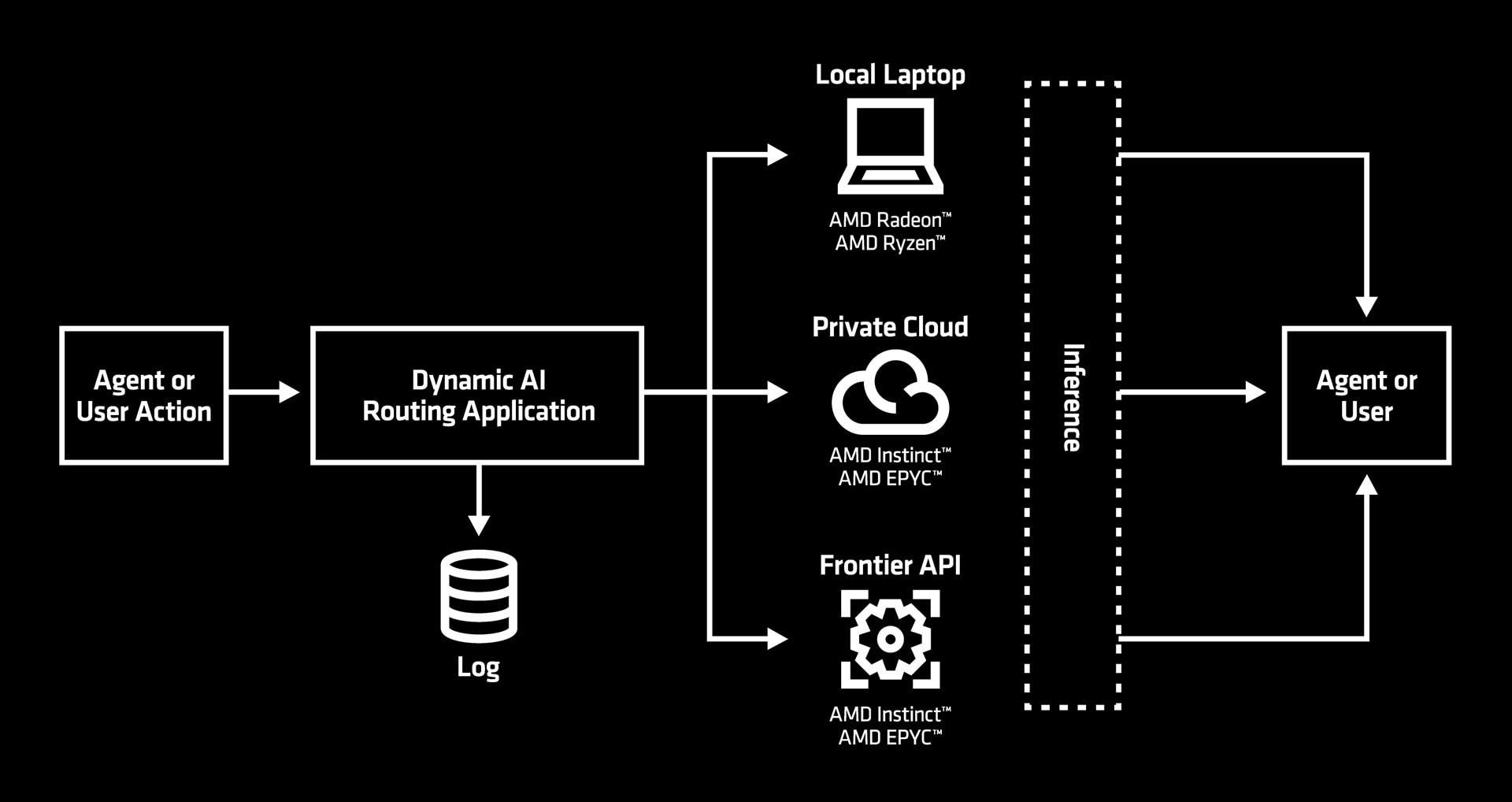
How Does Routing Work? AMD Silo AI provides model routing that can dynamically span on-device and cloud-deployed AI models. The routing policy determines where data should be processed and which AI model should handle it based on factors including sensitivity, cost, model capability and performance.
What Does AMD Offer? AMD offers consistent AI infrastructure across client, edge and cloud tiers.
On the device, AMD Ryzen™ AI platforms enable local AI through the CPU, NPU and integrated graphics. AMD Radeon™ integrated and discrete graphics provide additional acceleration for models and multimodal workloads. In private and cloud environments, AMD EPYC™ server CPUs and AMD Instinct™ GPUs support more capable models with higher throughput, longer context windows, centralized governance and controlled enterprise deployment.
AMD technologies are ideal when workloads are sensitive, ambiguous, high value or require more advanced analysis than a local device can provide. At the same time, they support privacy-sensitive digital journeys where frequent, latency-sensitive interactions are best kept close to the user whenever possible.
Built on AMD products, Lemonade is an open-source local AI serving layer that gives developers a practical way to expose local models through a familiar API while leveraging available AMD client hardware instead of sending every request to a remote service. It turns the device-to-cloud concept into a deployable architecture. Lower-risk requests can route through a Lemonade endpoint running on AMD client systems, using Ryzen AI CPU/NPU resources and Radeon graphics where available. Higher-risk workloads can route to endpoints backed by AMD EPYC and AMD Instinct infrastructure. This allows application logic to focus on routing policy while the endpoint abstraction determines where inference runs.
What Threats Does This Address? AI agents can encounter manipulated reviews, hidden instructions or unsafe decision paths on otherwise legitimate websites. These risks become more significant when agents move beyond providing information and begin taking actions.
“When AI agents start acting on our behalf, they bring a new class of challenges and threats to digital journeys and user trust,” said Santeri Kangas, chief technology officer, F-Secure. “This trust is built by AI models that preserve the user’s privacy while protecting both the user and their agent. To run these models effectively requires dynamic routing decisions. What we are building is a significant step forward in protecting consumers’ digital journeys and their privacy.”
What Does This Look Like in Action: Agentic shopping compresses many trust conditions into one journey. The lesson is that a safe domain does not automatically make every content segment safe, and a capable AI agent should not be allowed to treat every piece of text as an instruction. The routing layer gives the application a place to enforce that distinction.
Journey Moment | Example Event | Likely Route | Why |
Discovery | The agent compares public product pages and prices. | Local via Lemonade | Low sensitivity, frequent calls, low latency and no need to move data unnecessarily. |
Review analysis | A review is overly promotional or contains instruction-like text. | Private AMD inference | The site may be safe, but the segment is untrusted and may require stronger analysis. |
Selection | The agent recommends a high-value or sensitive product. | Private route or user confirmation | Financial exposure and product sensitivity increases the risk level. |
Checkout | Payment, account login, precise location or delivery details appear. | Private only/no external fallback | Sensitive data must respect the user’s privacy policy and consent limits. |
Post-purchase | Delivery, return, refund or support workflow begins. | Local or private depending on data | The route changes as the journey moves from public information to account-specific action. |
When will TrustPath be Available? F-Secure TrustPath capabilities are expected to enter beta in the fourth quarter of 2026 and production in 2027.
More:
Press inquiries: corporate.pressinquiry@amd.com