AAI 2026: AMD Introduces Open, Turnkey Integrated Platform for Physical AI
AMD Kria AI solutions extend robotics capabilities from body to brain and combine the Kria AI SOM, robotics developer platform and open software ecosystem to accelerate physical AI.
What’s the News? Today at Advancing AI 2026, AMD introduced AMD Kria™ AI Solutions, designed to help developers and customers prototype, build and rapidly deploy next-generation autonomous robotics and physical AI systems. The portfolio includes AMD Kria AI system-on-modules (SOMs) and robotics carrier card, powered by AMD Ryzen™ AI Embedded X100 Series processors, and the AMD Kria AI Robotics Developer Platform, the first open, turnkey integrated platform for autonomous robotics combining heterogeneous CPU, GPU, NPU and FPGA compute. It extends AMD robotics capabilities from the robot body to the robot brain, bringing AI perception, reasoning, and agentic decision-making and control together on a single platform optimized for stringent power, thermal and latency requirements.
Why It Matters? The robotics industry is evolving beyond deterministic automation to intelligent, autonomous systems that require AI perception, reasoning, and real-time decision-making and control. Developers need fully integrated platforms that simplify system design while accelerating deployment of increasingly complex physical AI systems. AMD Kria AI SOMs feature the Ryzen AI Embedded X100 series with up to 16 “Zen 5” CPU cores for real-time control, an AMD RDNA™ 3.5 iGPU for immersive graphics and a power-efficient NPU to deliver low-latency deterministic performance in a modular, production platform. It’s supported by an open software ecosystem that enables developers to build and deploy physical AI systems without vendor lock-in.
What’s the Role for AMD?
For decades, AMD adaptive computing technologies have powered the sensing, safety and real-time control systems at the heart of industrial and surgical robots. Today, we're extending that leadership from the robot body to the robot brain with the AMD Kria AI SOM and Robotics Developer Platform and we’re enabling customers to build more intelligent physical AI systems, bringing AI perception, reasoning, agentic decision-making and control together on the first open, turnkey integrated platform for autonomous robotics. Built on open standards and an open software ecosystem, the platform gives customers the flexibility to choose the models, frameworks and technologies that best fit their applications while reducing the complexity of moving from development to production.
What Do Kria AI Solutions Offer? The AMD Kria AI Robotics Developer Platform is designed to provide a scalable path from development to deployment. The fully integrated platform for agentic robotics includes the Kria AI SOM and robotics carrier card, evaluation kit, robotics software suite and validated reference designs.
The Kria AI SOM heterogeneous compute architecture powers the robot brain by enabling AI perception, reasoning, autonomous decision-making and action on a single platform, supported by the AMD Robotics Software Suite, an open, portable software stack built on AMD ROCm™ software and the ROS 2 robotics framework that is optimized for end-to-end development. Together with AMD adaptive SoCs and FPGAs, they provide a complete and scalable foundation for accelerating the deployment of next-generation robotics and physical AI systems from concept to production.
What Makes Kria AI Solutions Different? AMD Kria AI SOMs feature Ryzen AI Embedded X100 Series processors on an open-standard COM-HPC form factor SOM, combining CPU, integrated GPU and NPU compute in a modular architecture optimized for robotics and autonomous systems. The unified memory architecture helps reduce explicit data movement across compute domains, while the CPU, graphics and AI compute engines support real-time decision-making and control, AI inference and concurrent robotics workloads. It delivers deterministic real-time control with more than 8,000 control decisions every second, while simultaneously delivering sub-100 millisecond vision-language-action (VLA) AI reasoning.1 Leadership performance for robotics workloads includes up to 3.4x better real-time reliability2 for on-time control, up to 1.6x more free CPU cores3 for spare compute capacity and support for up to 2.3x more concurrent agents4 for agentic AI compared to Nvidia Jetson T5000.
What More Do I Need to Know? AMD Kria AI solutions support industry-standard frameworks including PyTorch, ONNX, ROS 2 and MoveIt while leveraging AMD ROCm software and the AMD Robotics Software Suite. The AMD open software stack supports easy CUDA-to-ROCm migration, enabling developers to preserve on average 75% of existing CUDA code,5 accelerating development with the AMD open, vertically integrated robotics software suite. Original design manufacturer (ODM) partner hardware platforms built on open standards provides a path from rapid prototyping to production deployment.
When will Kria AI solutions be Available? AMD Kria AI SOMs, powered by the Ryzen AI Embedded X100 Series processors, are expected to be available from ODM partners starting in the fourth quarter of 2026. The Kria AI Robotics Developer Platform is sampling with early access customers and is expected to be generally available in the fourth quarter of 2026.
More:
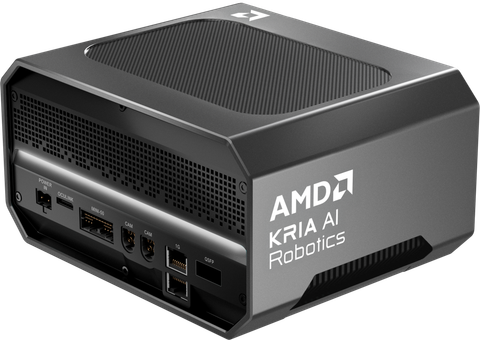
An upfront view shows the AMD Kria AI Robotics Developer Platform, the first open, turnkey integrated platform for agentic robotics. It was introduced at Advancing AI 2026 as part of AMD Kria AI solutions. (Credit: AMD)
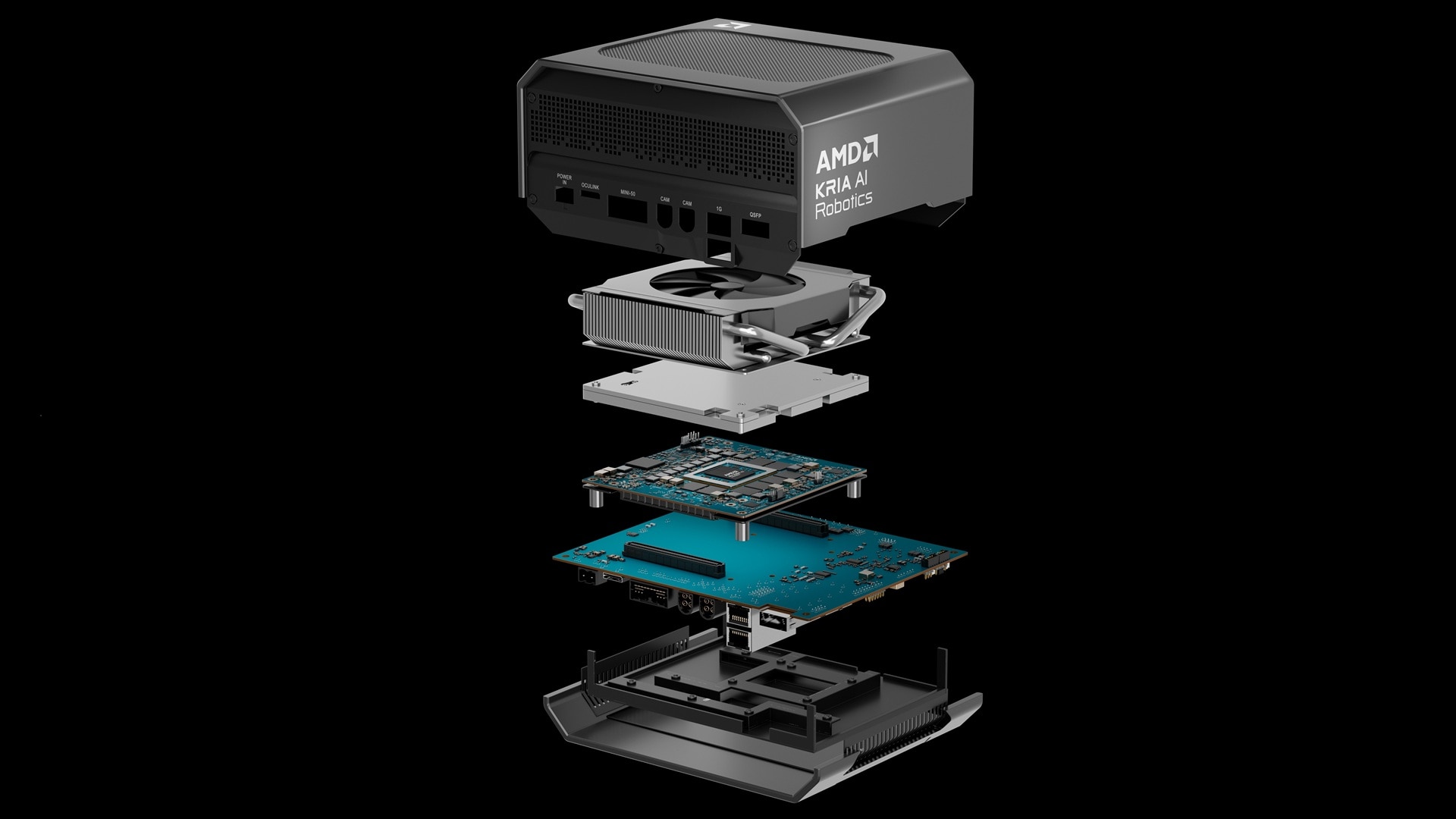
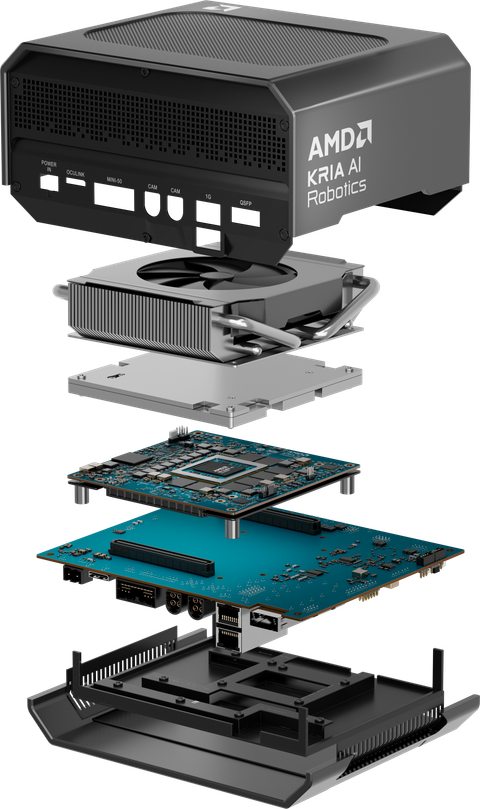
An exploded view shows the AMD Kria AI Robotics Developer Platform, the first open, turnkey integrated platform for agentic robotics. It was introduced at Advancing AI 2026 as part of AMD Kria AI solutions. (Credit: AMD)
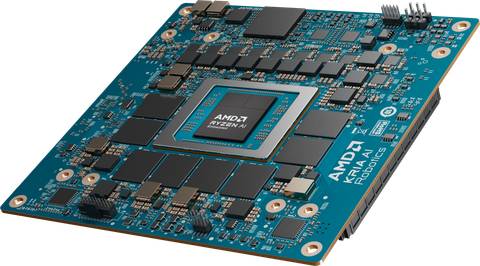
An angled view shows the lidless AMD Kria AI system-on-module, a compact, production-ready module, powered by the AMD Ryzen AI Embedded X100 Series processor. It was introduced at Advancing AI 2026 as part of AMD Kria AI solutions. (Credit: AMD)


Cautionary Statement
This blog may contain forward-looking statements concerning Advanced Micro Devices, Inc. (AMD), which are made pursuant to the Safe Harbor provisions of the Private Securities Litigation Reform Act of 1995. Forward-looking statements are commonly identified by words such as "would," "may," "expects," "believes," "plans," "intends," "projects" and other terms with similar meaning. Investors are cautioned that any forward-looking statements in this blog are based on current beliefs, assumptions and expectations, speak only as of the date of this blog and involve risks and uncertainties that could cause actual results to differ materially from current expectations. Such statements are subject to certain known and unknown risks and uncertainties, many of which are difficult to predict and generally beyond AMD's control, that could cause actual results and other future events to differ materially from those expressed in, or implied or projected by, the forward-looking information and statements. Investors are urged to review in detail the risks and uncertainties in AMD’s Securities and Exchange Commission filings, including but not limited to AMD’s most recent reports on Forms 10-K and 10-Q.
AMD does not assume, and hereby disclaims, any obligation to update forward-looking statements made in this blog, except as may be required by law.
-
8,000 Decisions per second (125us) obtained by running Bosch Rexroth controller on AMD X100 Series. Benchmark measures CPU real time control loop latency. Robot reasoning in <100ms benchmarking by embedL targeting GPU VLA inference latency (Based on Pi0.5 VLA )
-
Based on the OpenNav Robotics Workload Benchmark commissioned by AMD, published by Open Navigation LLC on July 23, 2026, as measured on the GMKtec EVO-X2 AI Mini PC AMD Ryzen™ AI Max+ 395 configured to reflect Ryzen AI Embedded X199 specifications (5.1 GHz CPU, 2.9 GHz GPU, 120W TDP, LPDDR5X-7500), vs the NVIDIA Jetson T5000 Developer Kit: https://opennav.org/news/opennav-robotics-workload-benchmark (REX-018)
-
Based on the OpenNav Robotics Workload Benchmark commissioned by AMD, published by Open Navigation LLC on July 23, 2026, as measured on the GMKtec EVO-X2 AI Mini PC AMD Ryzen™ AI Max+ 395 configured to reflect Ryzen AI Embedded X199 specifications (5.1 GHz CPU, 2.9 GHz GPU, 120W TDP, LPDDR5X-7500), vs the NVIDIA Jetson T5000 Developer Kit: https://opennav.org/news/opennav-robotics-workload-benchmark (REX-016)
-
Based on the mimik whitepaper “Architectural Fit for Production-Scale Agentic AI on Heterogeneous SoCs” commissioned by AMD, published by Mimik Technology, Inc. on July 23, 2026, based on a modeled sweep of 455 feasible agentic AI workflows across two device classes (X100, Jetson T5000), checking spare CPU, GPU, and memory. For more information see: https://www.mimik.com/agentix-compute-benchmarking (REX-019)
-
Based on AMD internal testing as of April 2026, validated on an AMD Ryzen™ AI Max+ 395 processor as a proxy for AMD Ryzen™ AI Embedded X100 Series CPUs, a CUDA-to-HIP validation suite consisting of 15 CUDA sample applications totaling 1,199 lines of code was migrated from CUDA to HIP. Code preservation was calculated as the percentage of original CUDA source retained after HIP conversion. Foundational workloads consisted of saxpy, matrix transpose, histogram, image blur, and prefix sum. Compute-intensive workloads consisted of warp reduction, N-body, SpMV, multi-stream, and cuBLAS GEMM. AI/ML workloads consisted of softmax, layer normalization, attention, convolution, and radix sort. Actual results may vary based on application complexity, CUDA library usage, architecture-specific optimizations, low-level CUDA constructs, required code modifications following conversion, or other factors. (REX-020)
Press inquiries: corporate.pressinquiry@amd.com
More from this category
 Embedded
AAI 2026: New AMD Open Robotics Partner Network for Physical AI Development
Expanded open ecosystem of software developers, AI model providers, robotics technologies, hardware partners and industry groups accelerates path to production for AMD platform-powered robotics.
 Embedded
AAI 2026: AMD Delivers Leadership Heterogeneous Compute for Physical AI
AMD extends the Ryzen AI Embedded processor family combining CPU, GPU and NPU acceleration to power robotics, industrial automation and intelligent embedded systems.
 Embedded
AMD Packs More Memory Capacity, Performance in a Smaller Design with Versal Premium Gen 2 Memory on Package
The AMD adaptive SoCs integrate up to 32 GB of LPDDR5X to boost bandwidth, reduce board space and speed development for AI, networking, aerospace and defense applications.
 Embedded
AMD FPGAs Help ModRetro Bring Retro Gaming Back to Life with M64 Console
ModRetro brings an authentic Nintendo N64-compatible gaming experience to a new generation of gamers by leveraging AMD Artix UltraScale+ FPGAs in its new M64 console.