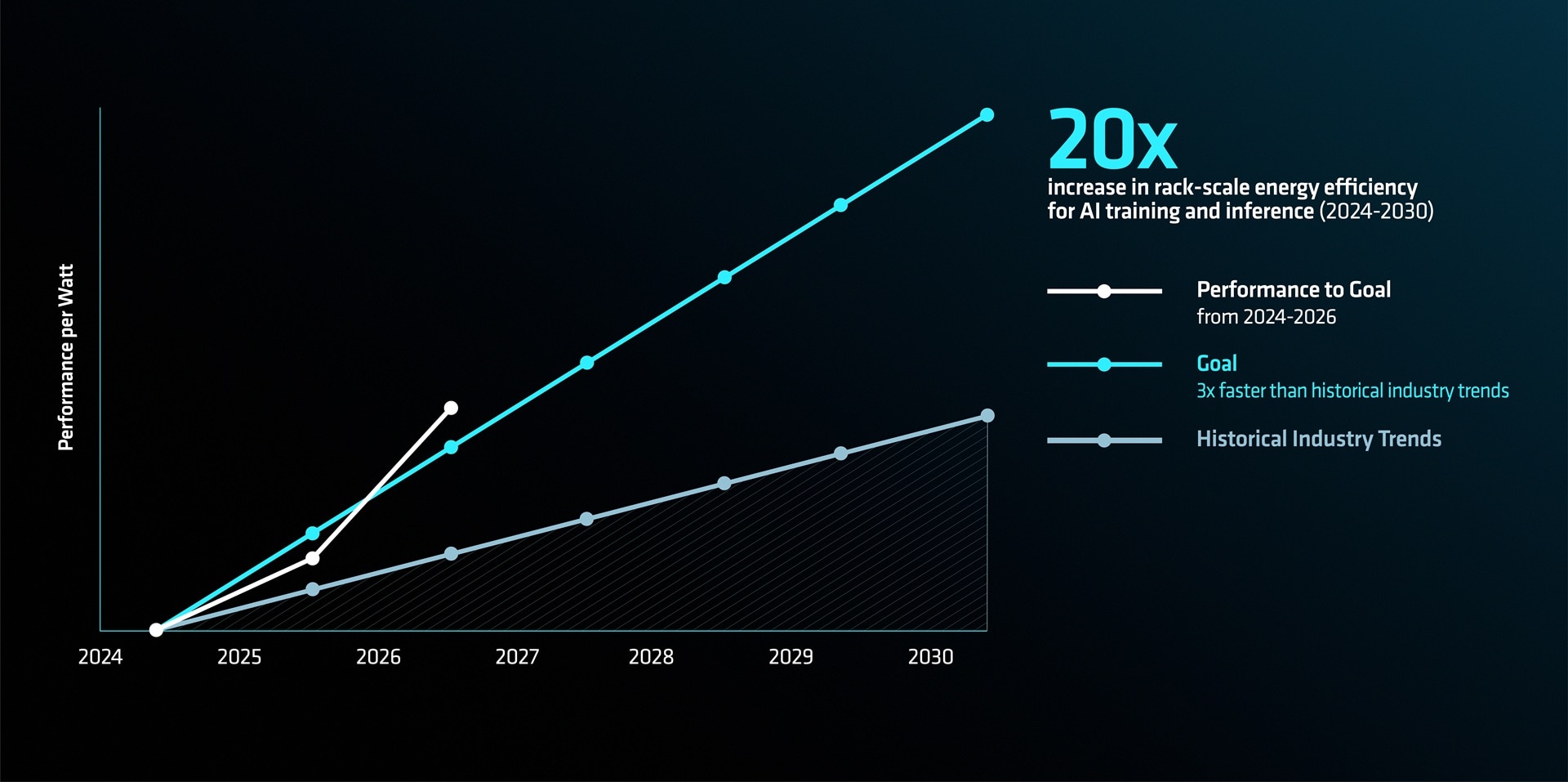
What’s the News? AMD has achieved an estimated 4x increase in AI energy efficiency as of mid-2026, ahead of its 3x projected target for this stage and more than double the historical trendline for the same point. This progress shows AMD is building momentum toward its 2030 goal to deliver a 20x increase in rack-scale energy efficiency for AI training and inference.1 2 It also reflects the work being done by AMD across silicon, systems and software to help customers scale AI workloads more efficiently.
Why It Matters? AI compute is accelerating rapidly, raising the bar for what data center infrastructure needs to deliver. Meeting that demand requires innovation across the whole stack: CPUs, GPUs, networking, software, power and cooling all need to work together efficiently at the rack and data center level. Improving energy efficiency can help deliver more AI performance without increasing power, improve total cost of ownership and help customers scale faster.
What’s the Role of AMD?
The next wave of AI efficiency will depend on tighter co-optimization across compute silicon, memory, interconnects, software and rack-scale system design. Our estimated 4x improvement through 2026 reflects the strength of our approach and the progress AMD is making across the full system, putting us ahead of our projected pace toward the 2030 goal.
What Efficiency Gains are Expected? Based on a representative AI training workload, AMD projected rack-scale energy-efficiency gains are expected to produce one of two related benefits by 2030:3
Same compute, fewer resources: Approximately two 2030 AMD racks are expected to deliver the same compute as 570 racks in 2024, enabling a reduction in use-phase electricity by 20x and carbon intensity by 28x.
More compute, same energy: Alternatively, efficiency gains are expected to enable 20x more compute, measured in floating point operations per second (FLOPs) per watt, using the same amount of energy.
How is AMD Increasing Efficiency? AMD is working to increase efficiency across the full AI stack through advances in compute architecture, process technology, memory bandwidth, data movement, interconnects, software and system-level co-design. The goal is to deliver substantially more compute performance without requiring energy consumption to grow at the same pace.
As AI infrastructure scales from individual nodes to full racks, efficiency increasingly depends on how well CPUs, GPUs, memory, networking, storage and software work together. AMD is applying system-level co-design, with teams working across product categories, to help reduce bottlenecks, move data more efficiently and improve performance per watt across the platform.
What’s the Foundation for Efficiency Gains? Beyond software optimization, three primary factors drive AI system performance: compute capability, memory bandwidth and interconnect bandwidth. Advanced process technology and architectural improvements help increase floating-point compute performance per watt. Advanced architectures and memory integration improve bandwidth, while high-speed interconnects and tighter integration increase the network bandwidths. Together, AMD expects these innovations to deliver 20x more AI performance per watt by 2030 compared with 2024.
Why Do Memory and Interconnects Matter? Modern AI workloads depend on moving large amounts of data efficiently. Improving memory bandwidth, bandwidth density and bandwidth per watt helps keep compute engines fed while reducing wasted power. High-bandwidth memory, larger caches and tighter integration between memory and compute can reduce unnecessary data movement, which costs energy.
Interconnect technology has also become an important part of efficient AI infrastructure as larger models and workloads increasingly depend on how efficiently GPUs, CPUs and other system components work together. High-speed scale-up interconnects help larger systems reduce bottlenecks and share data more efficiently.
How Does Software Help? Hardware provides the foundation, but software helps unlock continued efficiency gains. The AMD ROCm™ software stack, open standards and close customer collaboration help developers and organizations deploy AI workloads more efficiently on AMD platforms. Open ecosystems also support broader optimization across AI and high-performance computing (HPC) deployments.
These optimizations can help improve both large-scale AI training and inference workloads, where improving throughput and reducing energy consumed per generated token are increasingly important as AI applications scale.
What’s the Customer Benefit? Customers need more useful compute for the energy available. The projected rack-scale efficiency gains AMD has set forth can enable AI and HPC customers to achieve data center-level gains in power and cooling infrastructure, which can be limiting factors to increasing compute performance. Better energy efficiency can help reduce operational electricity use, improve total cost of ownership, and support more sustainable AI and HPC growth.
More:
-
The AMD 20x30 energy-efficiency goal is based on representative AMD rack configurations that incorporate projected improvements across compute, memory and networking performance as well as power consumption. Additional methodology, assumptions and technical details are available on the AMD Data Center Sustainability webpage.
-
Progress toward the AMD 20x30 goal is measured by comparing annual AMD rack configurations against a 2024 baseline using a performance-per-watt methodology. The 2026 result reflects a combination of measured product data and modeled estimates where final performance data was not available. Additional assumptions, calculations and progress-to-goal details are available on the AMD Data Center Sustainability webpage.
-
AMD Projections are based on a representative AI training workload using AMD rack configurations, projected performance and power characteristics, and publicly available data sources, including Epoch.ai and International Energy Agency energy scenarios. Additional methodology, assumptions and calculation details are available on the AMD Data Center Sustainability webpage.
Press inquiries: corporate.pressinquiry@amd.com