What’s the News? AMD today introduced AMD Ross™, an agentic AI assistant designed to accelerate the complete embedded development flow – from architecting the design to optimization, debugging, PCB design, schematic review, software, AI and deployment of the actual system. AMD Ross enables natural-language tool interaction and the deployment of expert-developed agent skills, reusable workflows and a grounded AMD Knowledge Base that guide the entire design process. It connects to tools, scales expertise, automates proven repeatable workflows and analyzes results,1 helping engineers quickly move from design intent to implementation and dramatically accelerating typical embedded development cycles.
Why It Matters? AMD Embedded products span FPGAs, adaptive SoCs, x86 embedded processors and specialized edge AI platforms, all supported by a rich ecosystem of development tools and workflows. As designs become increasingly sophisticated, engineers have an opportunity to streamline how they apply these resources and proven engineering practices across the entire system development life cycle. By capturing expert methodologies as reusable agent skills, organizations can make specialized knowledge more accessible, enable more consistent execution and free engineers to focus on higher-value design challenges.
How Does AMD Ross Help Developers?
Embedded development is becoming increasingly complex as teams work across hardware design and debug, software development and deployment, AI inference, and system-level design. AMD Ross brings AMD Embedded tools, trusted knowledge and expert-authored workflows together in a single agentic AI experience grounded in the technologies and methodologies our customers use every day. AMD Ross brings the power of agentic AI to embedded developers to move product innovations from design intent to deployment faster by accelerating the entire life cycle.
What Does AMD Ross Support? AMD Ross supports the embedded development journey, from hardware design and debug to software and algorithm development, edge AI implementation and deployment. Using natural language, developers can ask AI agents to search documentation, check tool status, run commands, guide debugging and execute proven workflows.1 AMD Ross works across the entire AMD Embedded portfolio of tools to enable users to:
Perform hardware and software partitioning.
Implement high-level synthesis tool-based hardware designs.
Optimize silicon design and debug.
Develop embedded software applications and algorithms.
Optimize machine learning algorithms by using AMD embedded AI software.
Accurately estimate power and optimize for lower power.
Perform system schematic review and optimal board layout.
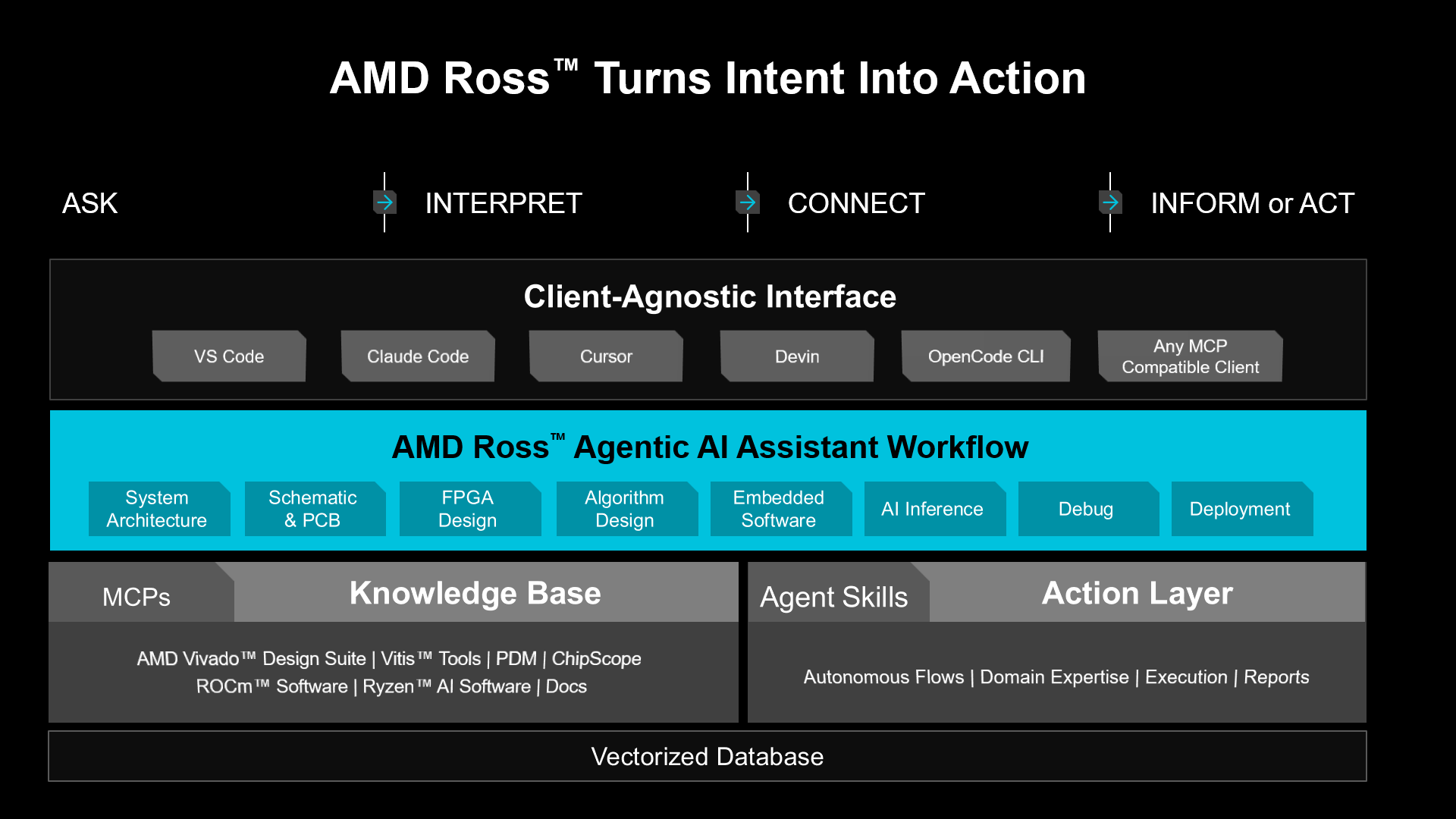
AMD Ross is client-agnostic, giving teams flexibility to use their preferred large language models (LLMs), integrated development environments (IDEs) and command-line environments while remaining connected to AMD Embedded development tools.
What Makes AMD Ross Unique? Unlike generic AI assistants, AMD Ross is built around AMD Embedded development environments, institutional AMD engineering knowledge and expert-authored methodologies. It’s not merely an AI coding assistant layered on top of development tools; it combines direct access to AMD development environments, AMD documentation, AMD-authored workflows and reusable engineering expertise into a purpose-built embedded development experience. AMD Ross delivers contextual guidance and workflow automation that generic copilots cannot provide, while remaining flexible through open support for all preferred LLMs, IDEs and command-line environments. AMD Ross does this by bringing together four purpose-built components:
Model context protocol (MCP) servers: Based on open-standard MCP servers, AMD Ross connects AI agents to AMD Embedded tools. This connection enables AMD Ross to query information, run commands and work within the design environment.
AMD Knowledge Base: AMD-validated vectorized databases contain user guides, product guides, white papers, application notes and answer records. They provide AMD validated answers and documentation access through the cloud or in an offline environment available locally.
Agent skills: Open, expert-authored markdown files capture repeatable, shareable best practices for common design tasks. These skills can guide an LLM through structured workflows such as timing optimization or restructuring of a C++ design for higher performance in Vitis HLS.
Design examples: Ready-to-run designs demonstrate how agent skills can be applied to real-world embedded applications.
What Can AMD Ross Accomplish? AMD Ross is designed to accelerate a development team’s journey from design intent to deployment, including:
Faster time-to-prototype through AI-assisted workflow automation.
Shorter debug and optimization cycles through AMD-validated guidance and reusable methodologies.
Higher developer productivity by automating repetitive tool interactions and tasks.
Accelerated onboarding of new engineers through access to proven expert workflows.
Consistent execution of best practices across teams and projects.
Greater reuse and scalability of institutional engineering knowledge.
“The AMD Ross agentic AI assistant has been a valuable addition to our development workflow. It helps us identify and troubleshoot issues more efficiently, reducing the time and effort required during the debugging and bring-up stages,” said Ms. Geetha Govindaraj, associate director, FPGA SOM BU, iWave Global.
AMD Ross-enabled workflow examples include:
Transforming natural-language intent into development actions by searching documentation, executing tool commands, generating code, iterating designs and guiding developers toward design goals.
Understanding and resolving tool errors through simplified explanations, contextual guidance and corrective recommendations.
Analyzing timing issues using AMD timing methodologies to identify violations, explain root causes and suggest implementation improvements.
Optimizing Vitis HLS designs through recommendations for pipelining, loop optimization, pragma insertion and architecture refinement.
Accelerating hardware debug through guided signal capture, debug-core configuration, interface analysis and root-cause identification.
When will AMD Ross be Available? AMD Ross represents a new approach to embedded development, combining agentic AI, AMD expertise and proven workflows to help teams work more efficiently across hardware, software, AI and system design. By making engineering know-how easy to access and reuse, AMD Ross helps organizations accelerate development, scale expertise and bring innovative products to market faster.
AMD Ross is available now. Developers can start their agentic AI journey at AMD.com/Ross. AMD plans to roll out additional AMD Embedded tools and workflow capabilities under AMD Ross on a monthly cadence.
-
AMD Ross operates within configured user permissions and supported tool environments. Users remain responsible for reviewing generated outputs, recommendations, and proposed actions before relying on or implementing them. Customers should not submit confidential, personal or regulated data unless authorized for use with the applicable model, tool and deployment configuration.
Press inquiries: corporate.pressinquiry@amd.com