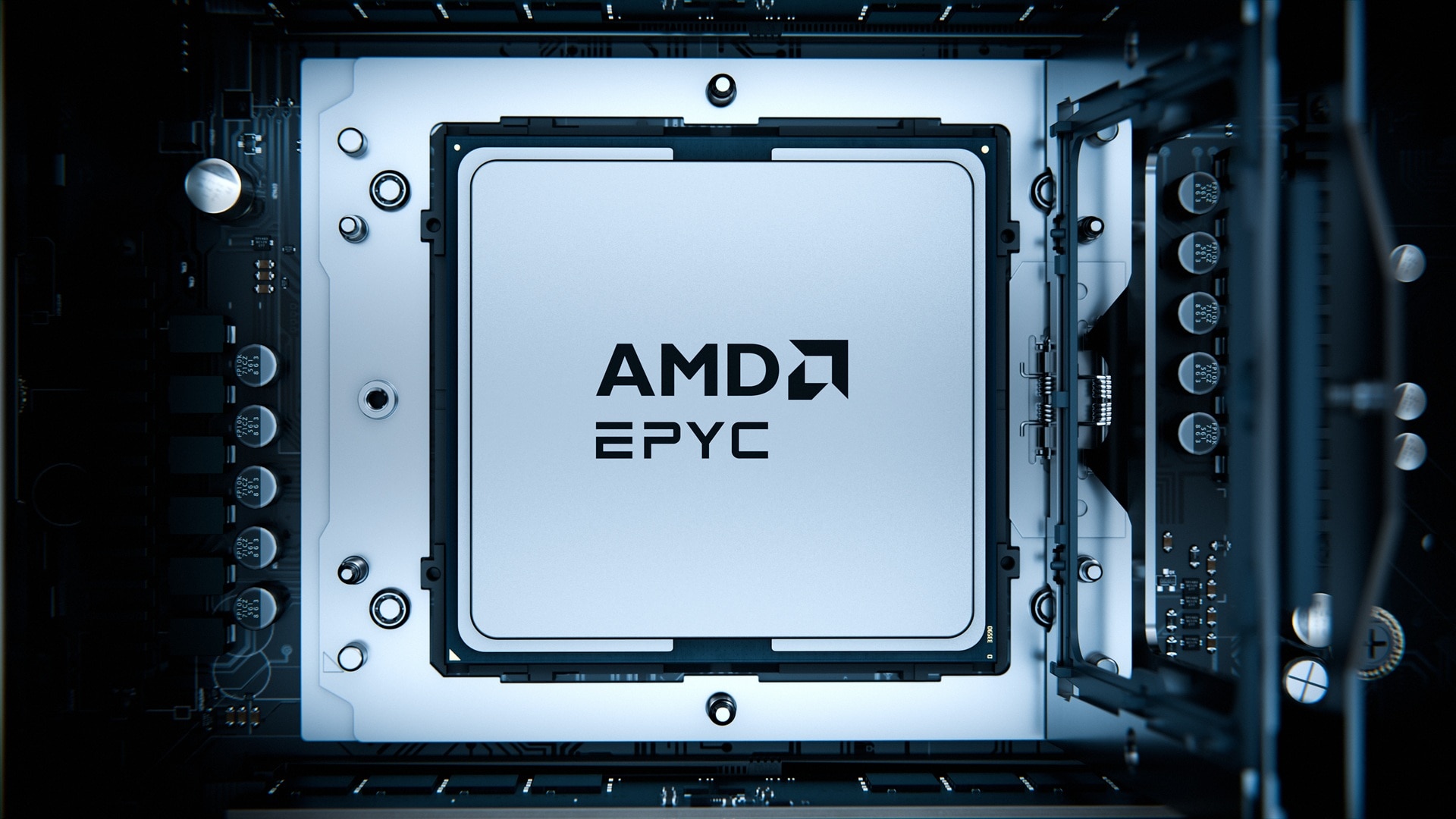
What’s the News? At Oracle AI World 2026, AMD shared updates to its multigeneration collaboration with Oracle to bring AMD technologies to Oracle Cloud Infrastructure (OCI) customers. OCI Compute E7 cloud compute instances will be powered by 6th Gen AMD EPYC™ server processors, supporting enterprise applications and the CPU services surrounding AI models. In addition, Oracle Acceleron converged NICs incorporate AMD Pensando™ data processing units (DPUs) for AMD CPUs and GPUs on OCI.
Why It Matters? Scaling AI requires powerful compute and efficient infrastructure services. CPUs coordinate agents, retrieve data and run enterprise applications, while networking technology moves data and offloads infrastructure tasks.
What’s AMD’s Role?
AMD EPYC processors and Pensando DPUs power workloads across AI, database, cloud-native and enterprise applications.
What Do E7 Instances Deliver? OCI Compute E7 instances, powered by 6th Gen AMD EPYC processors, will provide customers with advanced performance and capabilities for agent orchestration, concurrent agent sandboxes, retrieval services and in-memory caches, as well as web, API and enterprise application tiers. E7 Acceleron Standard virtual machines will offer flexible compute and memory configurations.
Learn more in the accompanying OCI blog, “Oracle Cloud Infrastructure and AMD Build an Open Foundation for AI at Scale."
How do AMD Pensando DPUs support OCI? As part of Oracle Acceleron converged NICs for OCI’s instances powered by AMD, AMD Pensando DPUs accelerate networking, storage and security functions in hardware, preserving host CPU capacity for customer applications while supporting the demands of AI, database, cloud-native and enterprise workloads.
As training, inference and agentic AI create new network demands, Pensando DPUs provide a programmable foundation that enables OCI to evolve networking, storage, security and observability services as workloads change.
Learn more in the accompanying AMD blog, “AMD Pensando™ DPUs: A Programmable Foundation for AMD-Based Oracle Acceleron SmartNICs.”
AMD Notes:
Oracle Cloud Infrastructure Notes:
Future Product Disclaimer: The preceding is intended to outline our general product direction. It is intended for information purposes only, and may not be incorporated into any contract. It is not a commitment to deliver any material, code, or functionality, and should not be relied upon in making purchasing decisions. The development, release, and timing of any features or functionality described for Oracle’s products remains at the sole discretion of Oracle. This information is for Oracle Cloud offerings and should not be relied upon for On Premise offerings.
Forward-Looking Statements Disclaimer: Statements in this article relating to Oracle’s future plans, expectations, beliefs, and intentions are “forward-looking statements” and are subject to material risks and uncertainties. Many factors could affect Oracle’s current expectations and actual results, and could cause actual results to differ materially. A discussion of such factors and other risks that affect Oracle’s business is contained in Oracle’s Securities and Exchange Commission (SEC) filings, including Oracle’s most recent reports on Form 10-K and Form 10-Q under the heading “Risk Factors.” These filings are available on the SEC’s website or on Oracle’s website at oracle.com/investor. All information in this article is current as of Oct. 27, 2026, and Oracle undertakes no duty to update any statement in light of new information or future events.
Trademarks: Oracle, Java, MySQL and NetSuite are registered trademarks of Oracle Corporation. NetSuite was the first cloud company—ushering in the new era of cloud computing.
Press inquiries: corporate.pressinquiry@amd.com