The future of quantum computing will depend on bringing quantum and classical computing together at unprecedented scale. Leadership-class classical computing is essential to managing quantum systems, accelerating complex simulations, correcting errors and integrating quantum processors with HPC clusters at scale. With leadership technologies spanning CPUs, GPUs, FPGAs and open software, AMD is uniquely positioned to build that foundation.
Today, AMD is applying its classical computing leadership to that challenge through a new codesign platform for quantum error correction established by IBM and the Quantum Science Center at Oak Ridge National Laboratory (ORNL). The collaboration provides a shared environment to evaluate the architectures, software and workflows that future hybrid quantum systems will require.
The new codesign platform will draw on the experiences of all three partners. IBM brings quantum computing technology, ORNL brings its scientific research and computing environment, and AMD brings the classical computing technologies and open software to connect quantum processing with scientific workloads.
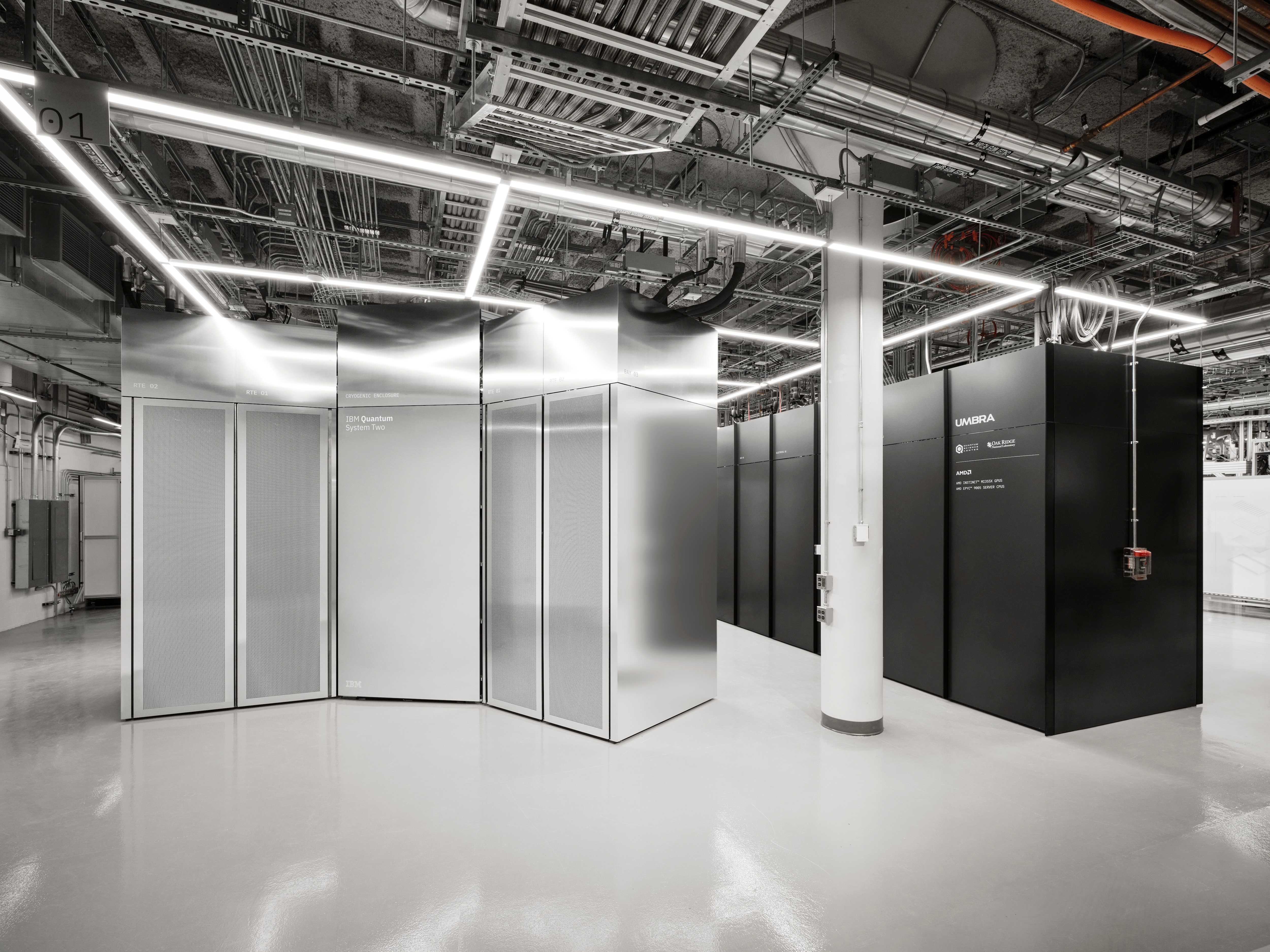
The first deployment brings together IBM quantum computers, including the 120-qubit IBM Quantum Nighthawk, and the Umbra HPC system, powered by AMD EPYC™ CPUs and AMD Instinct™ GPUs, in a colocated environment.
“Building useful quantum systems requires the quantum and classical computing communities to solve system design challenges together," Ralph Wittig, Corporate Fellow, Head of Research & Advanced Development, AMD. "AMD brings expertise across CPUs, GPUs and FPGAs, from real-time control to leadership-class supercomputing. With IBM, Oak Ridge and our ecosystem partners, we are applying that experience to develop and test how quantum processors, classical computing and software can work together at scale.”
This work builds on AMD’s experience powering leadership-class supercomputers and an ongoing collaboration with IBM across GPU-accelerated scientific calculations and FPGA-based error decoding.
Designing the Classical Foundation
Integrating quantum and classical computing requires matching different processing requirements within one system. Control and feedback demand precise timing and rapid responses. Scientific calculations require substantial parallel processing. And orchestration coordinates work across all these resources.
AMD works together with the ecosystem and its partners through deep codesign to utilize its broad high-performance portfolio to address the classical computing requirements of quantum systems from real-time control through leadership-scale scientific computing. AMD brings expertise across these requirements:
AMD EPYC™ CPUs provide the orchestration and general-purpose performance needed to coordinate complex hybrid classical-quantum systems.
AMD Instinct™ GPUs accelerate simulation, optimization and the parallel scientific computations surrounding quantum workloads.
AMD Versal™ adaptive SoCs provide the low-latency control, readout and decoding capabilities required near the quantum processor.
AMD ROCm™ open software ecosystem helps developers connect HPC and AI applications and this hardware into increasingly integrated quantum-classical environments.
Together, these technologies give quantum developers, system builders and research institutions a scalable classical foundation they can design around today.
AMD and Its Role in Quantum's Future
Error correction is what stands between the quantum computers we have today and the ones that can perform real science. Solving for that takes work on both quantum and classical computing, with a large part of it being on the classical side. Error correction requires quantum researchers to understand processors and classical computing as the two systems work side by side. The new codesign platform gives AMD, IBM and Oak Ridge National Laboratory a shared environment to investigate those requirements together as they continue support for the Department of Energy’s Quantum Genesis Mission and its progress toward a scientifically relevant quantum computer by 2028.
Plans call for connecting the platform with the Oak Ridge Leadership Computing Facility (OLCF), which also houses, ORNL’s new Lux SI (Super Intelligence) + HPC supercomputer, powered by AMD EPYC CPUs and AMD Instinct GPUs. Those connections will extend the research environment to the full-scale system necessary to explore how integrated quantum, AI and scientific computing can accelerate scientific discoveries and national security.
For AMD, the work reflects a foundational principle: Advances in quantum computing depend on progress in classical computing. By working with IBM and ORNL to investigate those requirements now, AMD shapes the computing foundation that future quantum computers will need. AMD is codesigning a holistic system with quantum companies, research institutions and technology providers.
Press inquiries: corporate.pressinquiry@amd.com