
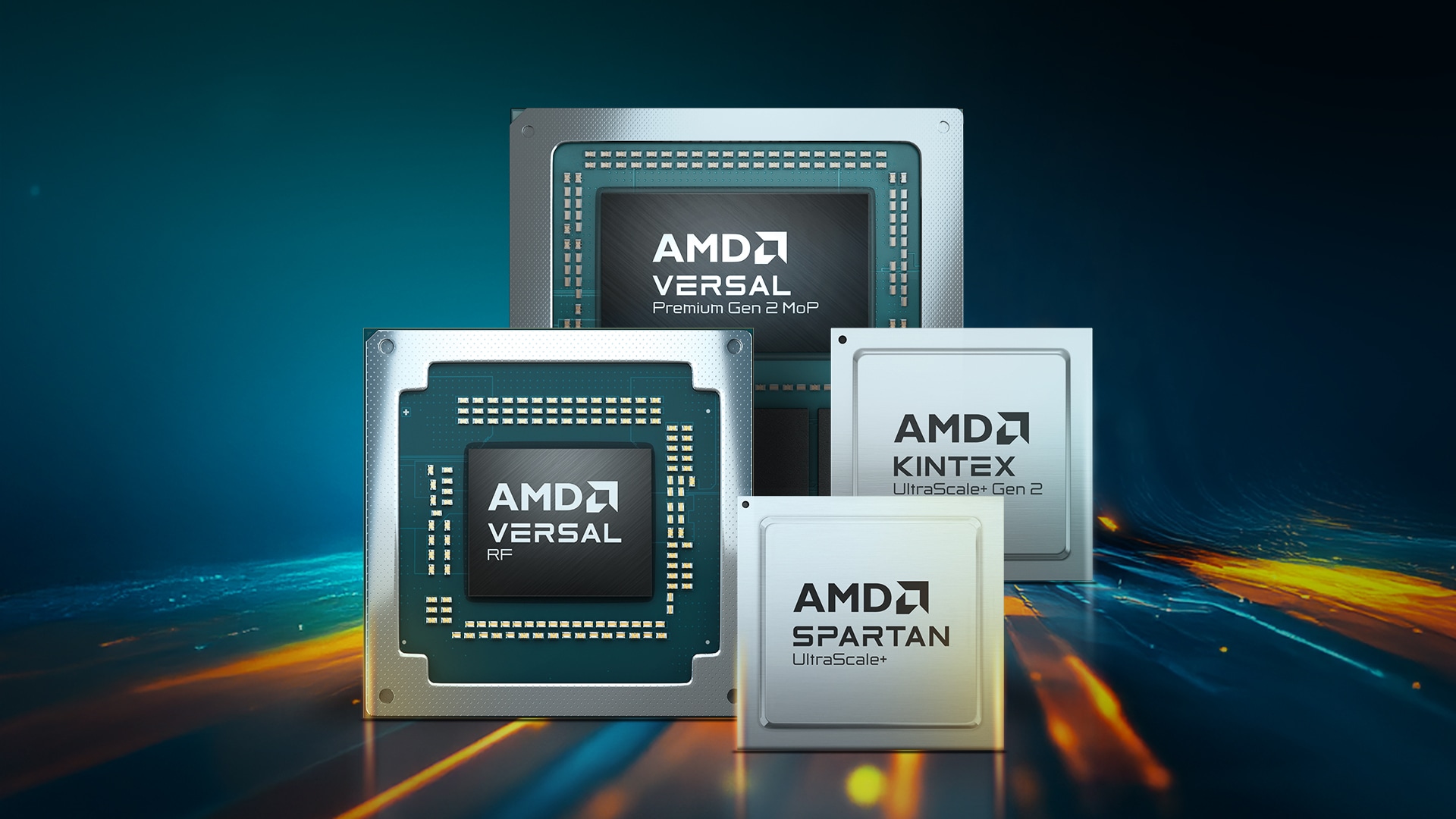
Three things to know:
AMD builds on decades of leadership in adaptive computing through sustained innovation, partnership continuity and long-term product support that gives customers confidence to plan across product generations.
AMD brings together a broad portfolio of compute architectures to meet the requirements of increasingly complex embedded designs and physical AI workloads.
AMD Embedded delivers semi-custom silicon solutions through a co-design partnership model that adapts AMD silicon to customer roadmaps and accelerates development.
FPGAs and adaptive computing have always been about giving engineers more ways to solve hard problems. As the inventor of the first commercially available FPGA and with decades of leadership experience in programmable logic, AMD is committed to advancing adaptive computing for the systems customers are building now and for whatever will come next.
As embedded systems grow more complex and AI moves into the physical world, customers need platforms that can evolve, integrate across technologies and remain dependable over long product life cycles. AMD brings together a vast portfolio of CPU, GPU, FPGA, adaptive SoC, NPU and networking IP to help customers match each workload to the right architecture. We’re also expanding into semi-custom silicon solutions, offering customers advantages that are hard to replicate based on the breadth of IP we have under one roof.
That means a semi-custom customer can compose a tailored SoC without licensing third-party cores or stitching together multiple vendors’ IP and taking on the integration risk. In addition, our modular chiplet approach lets AMD reuse proven dies across customers and mix process nodes, fundamentally improving semi-custom economics and time to market. Combined with the long product life cycles and functional-safety discipline that embedded customers require, AMD provides a true co-design partnership model that adapts AMD silicon to each customer’s roadmap. These strengths position AMD to power the next generation of custom silicon solutions in automotive, data center, networking, aerospace and defense, and purpose-built AI accelerator markets.
Innovation Built over Generations
Innovation in adaptive computing is cumulative. It takes years of engineering, close collaboration with customers and partners, and the ability to carry experience into each new generation of products.
The AMD Embedded portfolio spans FPGAs, adaptive SoCs and x86 embedded processors for a wide range of applications and markets. We continue to invest in architectures, packaging, interconnects, software and tools that make adaptive computing more accessible and give developers greater flexibility in how they design, build and evolve systems.
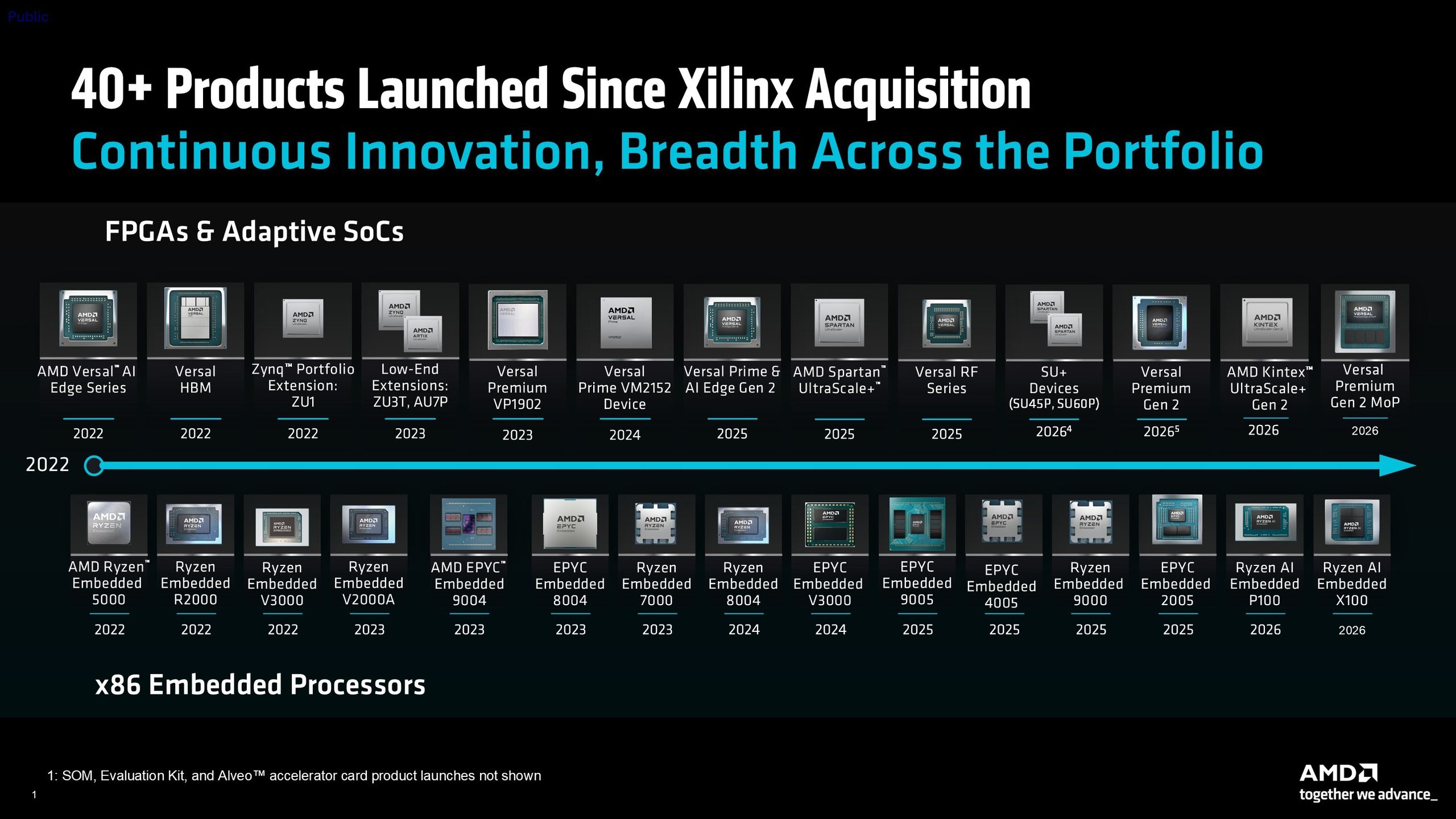
Since Xilinx became part of AMD in 2022, our investment in FPGAs and adaptive SoCs has accelerated. We have launched more than 40 new embedded products, with the low-end of the portfolio spanning the Spartan™ 7, UltraScale+™ and Zynq™ UltraScale+™ SoC and FPGA families; the mid-range including Versal™ Prime series adaptive SoCs and Kintex™ UltraScale+™ Gen 2 FPGAs; and the high-performance of Versal™ Premium Series Gen 2 devices, alongside an expanded x86 embedded processor lineup. Shared architectures and development tools across our FPGA and adaptive SoC portfolio help customers scale and reuse designs while planning for long product life cycles.
Chiplet integration illustrates the value of sustained investment. AMD pioneered stacked silicon interconnect (SSI) technology with TSMC in 2007 and has brought five generations of adaptive products to market across 28 nanometer, 20 nm, 16 nm, 7 nm and 6 nm process nodes. That experience matters because advanced packaging is not a one-generation technology decision. Customers need to know the architecture they choose today has engineering depth behind it and a roadmap ahead of it.
Radio frequency (RF) technology is another area of sustained investment and leadership. Building on the success of the Zynq™ RFSoC devices, the highly integrated Versal™ RF Series heterogeneous computing solution is the fifth generation of AMD direct RF devices. It’s the industry’s first direct RF device to combine RF conversion, signal processing, programmable logic and an Arm® subsystem in a single chip. This integration helps customers address system complexity, power and footprint requirements without assembling those capabilities across separate devices.
AMD is also the first to directly integrate LPDDR5X memory into an adaptive SoC package to enable faster data transfers compared to discrete solutions. Built for long life cycles and industrial-grade environments, Versal Premium Series Gen 2 Memory on Package (MoP) devices integrate 32 GB LPDDR5X into a single package with a high-end adaptive SoC to deliver up to 288 GB/s of bandwidth in up to 60% less board area. With LPDDR5X and 15-plus-year life cycle support, Versal Premium Gen 2 MoP devices help decouple product availability from high-bandwidth memory’s (HBM) shorter, data-center-driven refresh cycles, reducing the risk of forced redesigns caused by memory end of life or limited availability.
Today, DDR5/LPDDR5X is standard across the Versal RF and Versal Series Gen 2 device families for AI and designs constrained by SWAP (size, weight and power) that demand low power at the highest bandwidth. Our customers should be able to design the system they want to build, not the one their memory constraints dictate.
Developer tools are equally important. The Vivado™ design suite and Vitis™ software platform build on decades of FPGA design experience to help engineers manage complex designs, reuse IP and meet implementation timing goals. An extensive IP catalog, third-party ecosystem and established developer community support customers as they move from architecture to implementation.
Partner Continuity and Confidence
Customers making long-term technology decisions need partners who understand complex designs and will be there across multiple product generations.
The AMD and TSMC relationship spans generations of process technology and adaptive product development, providing an established design and manufacturing foundation. For embedded customers, long-term product availability is critical for continuity and planning because the life of the system can extend well beyond a typical refresh cycle.
AMD’s published life cycle plans extend manufacturing availability across AMD 7 Series FPGAs through 2040 and UltraScale+ and Versal device availability through at least 2045. AMD EverReady and LEAP programs provide additional life cycle and supply-assurance options for qualifying products and customers.
Trust also depends on security. AMD designs security into the silicon across the entire adaptive computing portfolio. From Spartan™ UltraScale+™ FPGAs to Versal adaptive SoCs, AMD provides security capabilities including NIST-aligned asymmetric post-quantum cryptography for the highest level of confidentiality, advanced countermeasures against side-channel attacks and layered anti-tamper protection with hardware root-of-trust security.
Making Adaptive Computing More Accessible
The future of adaptive computing depends not only on silicon, but on making that silicon easier to use. AMD recently introduced the AMD Ross™ agentic AI assistant that enables developers to interact with AMD Embedded tools using natural language.
AMD Ross spans software, silicon and board design to accelerate embedded system design, optimization, debug and deployment. It works with Vivado, Vitis HLS and AMD knowledge resources, helping make expertise and repeatable development workflows more accessible.
Developers also remain in control. Ross can propose actions for review, while customers decide whether to proceed. AMD plans to add new capabilities under AMD Ross on a monthly release cadence.
Building What Comes Next
The state of adaptive computing is as strong as ever, and the opportunities ahead are even greater.
Adaptive computing leadership is earned over generations through sustained innovation, a roadmap customers can plan around and the engineering discipline to support products across the life of their designs. But longevity does not mean standing still.
Embedded systems are becoming more heterogeneous. AI is moving into the physical world. And developers need to bring increasingly complex systems to market without making development itself more complex.
That’s where I see adaptive computing going next: It will play an increasingly important role in heterogeneous systems, with the flexibility to adapt as workloads and requirements evolve.
We’ve built the foundation for decades. Now we’re building it for what comes next.
Press inquiries: corporate.pressinquiry@amd.com